


Page 32 - Preventing Youth Violence
P. 32
through the dynamic process of identifying clients and treating with their criminogenic

                 needs, case management has served to reduce risk factors in clients while strengthening
                 their protective factors that resulted in the transformation of some of the most vulnerable

                 clients served by the programme.

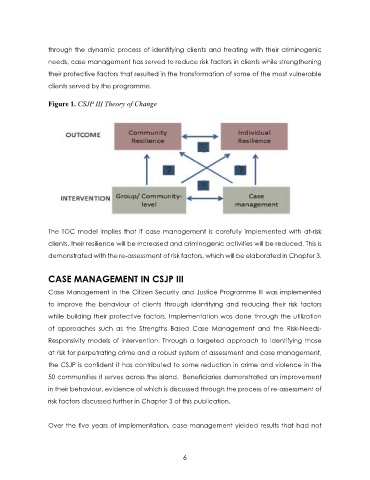
                 Figure 1. CSJP III Theory of Change


                 The  TOC  model  implies  that  if  case  management  is  carefully  implemented  with  at-risk
                 clients, their resilience will be increased and criminogenic activities will be reduced. This is

                 demonstrated with the re-assessment of risk factors, which will be elaborated in Chapter 3.


                 CASE MANAGEMENT IN CSJP III

                 Case Management in the Citizen Security and Justice Programme III was implemented

                 to  improve the  behaviour  of  clients through  identifying and reducing  their  risk factors
                 while building their protective factors. Implementation was done through the utilization

                 of  approaches  such as the  Strengths  Based Case Management  and the  Risk-Needs-
                 Responsivity  models  of  intervention.  Through  a  targeted  approach  to  identifying  those

                 at risk for perpetrating crime and a robust system of assessment and case management,
                 the CSJP is confident it has contributed to some reduction in crime and violence in the

                 50 communities it serves across the island.  Beneficiaries demonstrated an improvement
                 in their behaviour, evidence of which is discussed through the process of re-assessment of

                 risk factors discussed further in Chapter 3 of this publication.


                 Over the five years of implementation, case management yielded results that had not


                                                              6

