


Page 66 - Social Norms Survey
P. 66
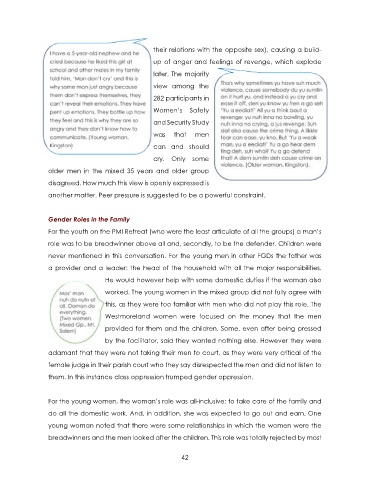
their relations with the opposite sex), causing a build-

                                                    up  of anger and  feelings  of revenge, which explode
                                                    later. The majority

                                                    view  among  the
                                                    282 participants in

                                                    Women’s  Safety
                                                    and Security Study

                                                    was    that   men
                                                    can and should

                                                    cry.  Only  some
                 older  men  in  the  mixed  35  years  and  older  group

                 disagreed. How much this view is openly expressed is
                 another matter. Peer pressure is suggested to be a powerful constraint.


                 Gender Roles in the Family

                 For the youth on the PMI Retreat (who were the least articulate of all the groups) a man’s
                 role was to be breadwinner above all and, secondly, to be the defender. Children were

                 never mentioned in this conversation. For the young men in other FGDs the father was
                 a provider and a leader: the head of the household with all the major responsibilities.

                                    He would however help with some domestic duties if the woman also
                                    worked. The young women in the mixed group did not fully agree with

                                    this, as they were too familiar with men who did not play this role. The
                                    Westmoreland  women  were  focused  on  the  money  that  the  men

                                    provided for them and the children. Some, even after being pressed
                                    by the facilitator, said they wanted nothing else. However they were

                 adamant that they were not taking their men to court, as they were very critical of the
                 female judge in their parish court who they say disrespected the men and did not listen to

                 them. In this instance class oppression trumped gender oppression.


                 For the young women, the woman’s role was all-inclusive: to take care of the family and
                 do all the domestic work. And, in addition, she was expected to go out and earn. One

                 young woman noted that there were some relationships in which the women were the
                 breadwinners and the men looked after the children. This role was totally rejected by most


                                                             42

