

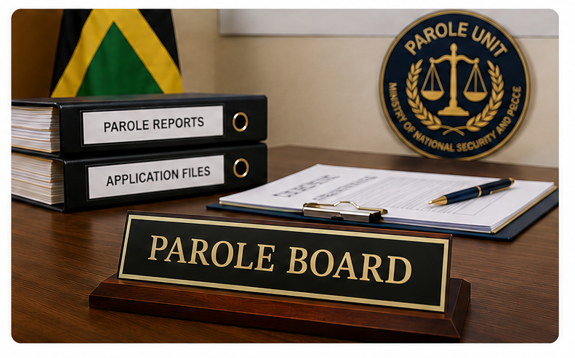
About the Parole Unit
The Parole Unit is responsible for coordinating and administering the parole process in Jamaica. The Unit provides administrative and technical support to the Parole Board by receiving, reviewing and processing parole applications before they are presented for consideration.
Parole is the conditional release of an offender from custody before the completion of a custodial sentence. Individuals granted parole are permitted to serve the remainder of their sentence within the community under supervision and subject to conditions imposed by the Parole Board.
The Unit supports the Government of Jamaica's commitment to offender rehabilitation while ensuring that community safety remains the paramount consideration in all parole decisions.
Eligibility for Parole
An offender must first complete the prescribed non-parole period before becoming eligible to apply for parole. The earliest date on which an offender may submit an application is known as the Parole Eligibility Date (PED).
The PED is determined by:
- One-third (1/3) of the maximum sentence, or twelve (12) months, whichever is greater; or
- Any longer non-parole period specifically ordered by the Court.
Meeting the eligibility requirements does not guarantee release on parole.
Applying for Parole
Eligible offenders must complete a Parole Application and submit it to the Superintendent of the Correctional Institution where they are incarcerated.
The application is forwarded to the Department of Correctional Services and subsequently transmitted to the Parole Unit for processing.
Following the completion of all required assessments and reports, the application is presented to the Parole Board for consideration.
The Parole Board
The Parole Board is an independent body appointed by the Minister responsible for Justice, National Security and Peace.
The current Board comprises experienced professionals representing various disciplines, including:
- Retired Judge (Chairperson)
- Psychologist
- Social Worker
- Pastor
- Ex-Offender Representative
- Commissioner of Corrections or Nominee
- Retired Police Officer
The diversity of the Board allows applications to be considered from legal, psychological, social and public safety perspectives.
Further information regarding the composition and functions of the Parole Board is provided in the Parole Act.
Factors Considered
The Board carefully reviews each application on its individual merits. Its foremost consideration is the safety of the public. Factors considered include:
- Criminal history
- Nature and circumstances of the offence
- Behaviour while incarcerated
- Evidence of rehabilitation
- Institutional adjustment
- Risk of reoffending
- Community support
- Victim concerns, where applicable
Reports Reviewed
In considering an application, the Board may review:
- Police Report
- Notes of Evidence
- Superintendent's Report
- Institutional Probation Report
- Community Probation Report
- Psychiatric and Psychological Reports
- Risk Assessments
- Drug Testing and Contraband Reports
- Any other relevant information
Possible Decisions
Following consideration of an application, the Board may make one of the following decisions:
- Grant Parole — the offender is released into the community under supervision and subject to specified conditions.
- Refuse Parole — the offender remains in custody and may become eligible for reconsideration in accordance with applicable legislation.
- Defer Consideration — the Board may postpone making a final decision pending the receipt of additional information or further assessment.
All applicants receive written notification of the Board's decision together with the reasons for the decision.
Community Supervision
Persons released on parole remain under the supervision of the Department of Correctional Services. Supervision assists offenders with successful reintegration while ensuring compliance with the conditions of parole. This balanced approach promotes rehabilitation, accountability and community safety.
Frequently Asked Questions
What is parole?
Parole is the conditional release of an offender before the completion of a custodial sentence.
Does becoming eligible guarantee parole?
No. Eligibility allows an offender to apply for parole. Release depends on the Parole Board's assessment of the application.
Who decides whether parole is granted?
The Parole Board.
What happens if parole is refused?
The offender remains in custody and may be reconsidered at a later date, where applicable.
What is the Board's primary consideration?
The protection and safety of the public.
What do I need in order to get information on an offender-client?
The family member, relative or friend listed on the application form as the contact person must present a valid Government-issued ID or Passport.
“Supporting safer communities through fair, transparent and accountable parole administration.”
For general enquiries, contact the Ministry of National Security & Peace at information@mns.gov.jm or +1 (876) 906-4908.