

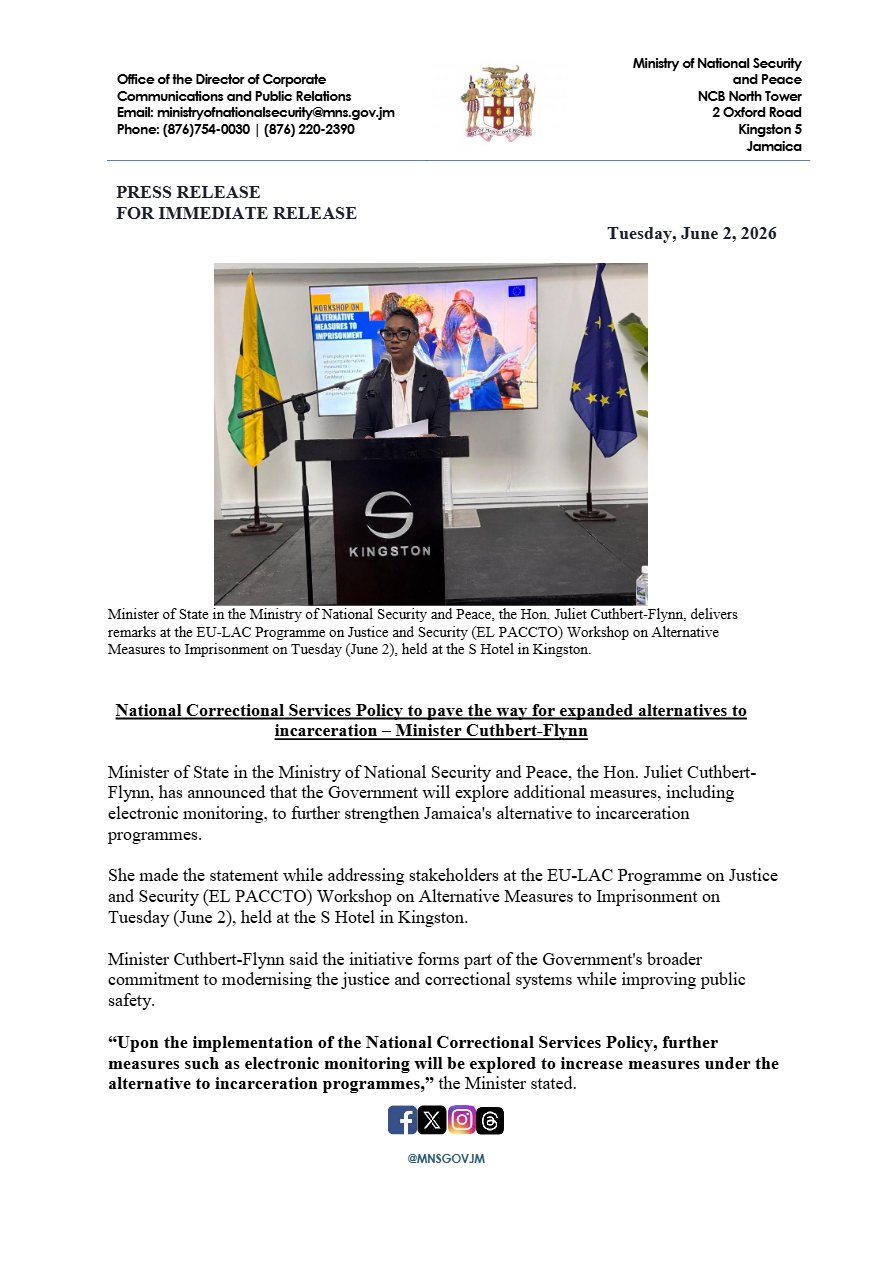
Minister of State in the Ministry of National Security and Peace, the Hon. Juliet Cuthbert-Flynn, has announced that the Government will explore additional measures, including electronic monitoring, to further strengthen Jamaica's alternative to incarceration programmes.
She made the statement while addressing stakeholders at the EU-LAC Programme on Justice and Security (EL PACCTO) Workshop on Alternative Measures to Imprisonment on Tuesday (June 2), held at the S Hotel in Kingston.
Minister Cuthbert-Flynn said the initiative forms part of the Government's broader commitment to modernising the justice and correctional systems while improving public safety.
“Upon the implementation of the National Correctional Services Policy, further measures such as electronic monitoring will be explored to increase measures under the alternative to incarceration programmes,” the Minister stated.
She noted that while the workshop focuses specifically on alternatives to imprisonment, it also contributes to a wider regional effort spearheaded through EL PACCTO 2.0 to combat transnational organised crime.
“It (EL PACCTO 2.0) represents one of the most significant international partnerships currently supporting efforts to combat transnational organised crime throughout Latin America and the Caribbean. Through technical assistance and cooperation, EL PACCTO 2.0 strengthens collaboration among criminal justice institutions across Latin America, the Caribbean and Europe, helping to build more effective and resilient systems,” she said.
Minister Cuthbert-Flynn highlighted that alternative measures to imprisonment include probation, diversion programmes, restorative justice initiatives, community service, mediation, counselling, and rehabilitation programmes. These approaches allow justice systems to respond more proportionately to offences based on the nature of the crime and the offender's risk profile.
She explained that such measures are central to justice reform because by itself, imprisonment does not always address the underlying causes of offending behaviour.
“By shifting the focus from punishment, community-based interventions can provide greater opportunities for support, rehabilitation and reintegration, particularly for non-violent and lower-risk offenders,” she added.
Furthermore, Minister Cuthbert-Flynn emphasised that alternatives to incarceration can contribute significantly to long-term public safety by reducing rates of reoffending and supporting offenders' reintegration through continued access to employment, education, family support, and rehabilitative services.
She noted that these measures form part of a broader preventative approach within the criminal justice system. However, she stressed that their success depends on strong institutional and legal frameworks, trained personnel, effective supervision mechanisms and robust evaluation systems.
“Without these safeguards, implementation challenges may undermine both effectiveness and public confidence in non-custodial approaches,” she cautioned.
Photos
View album in the Gallery →