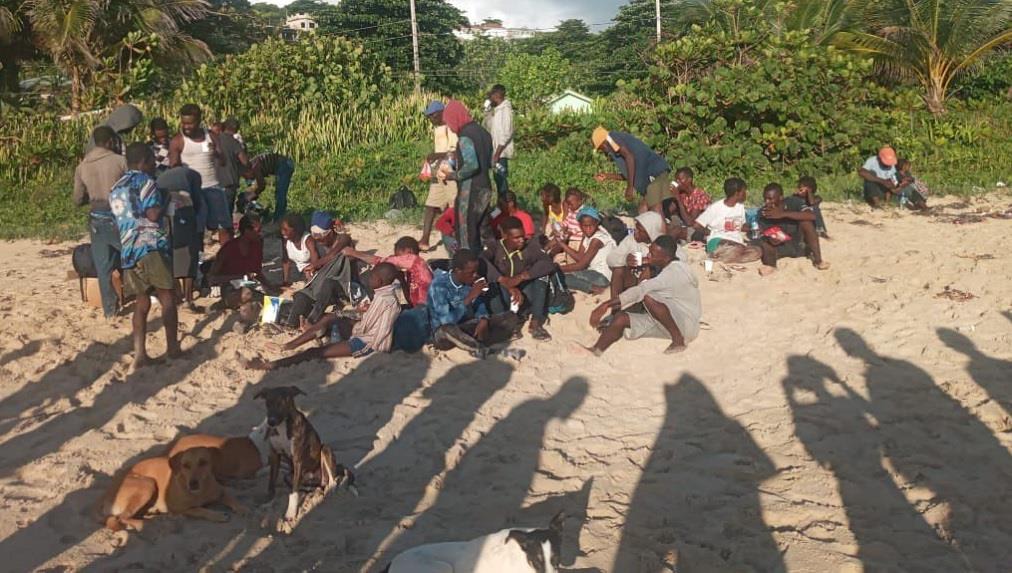
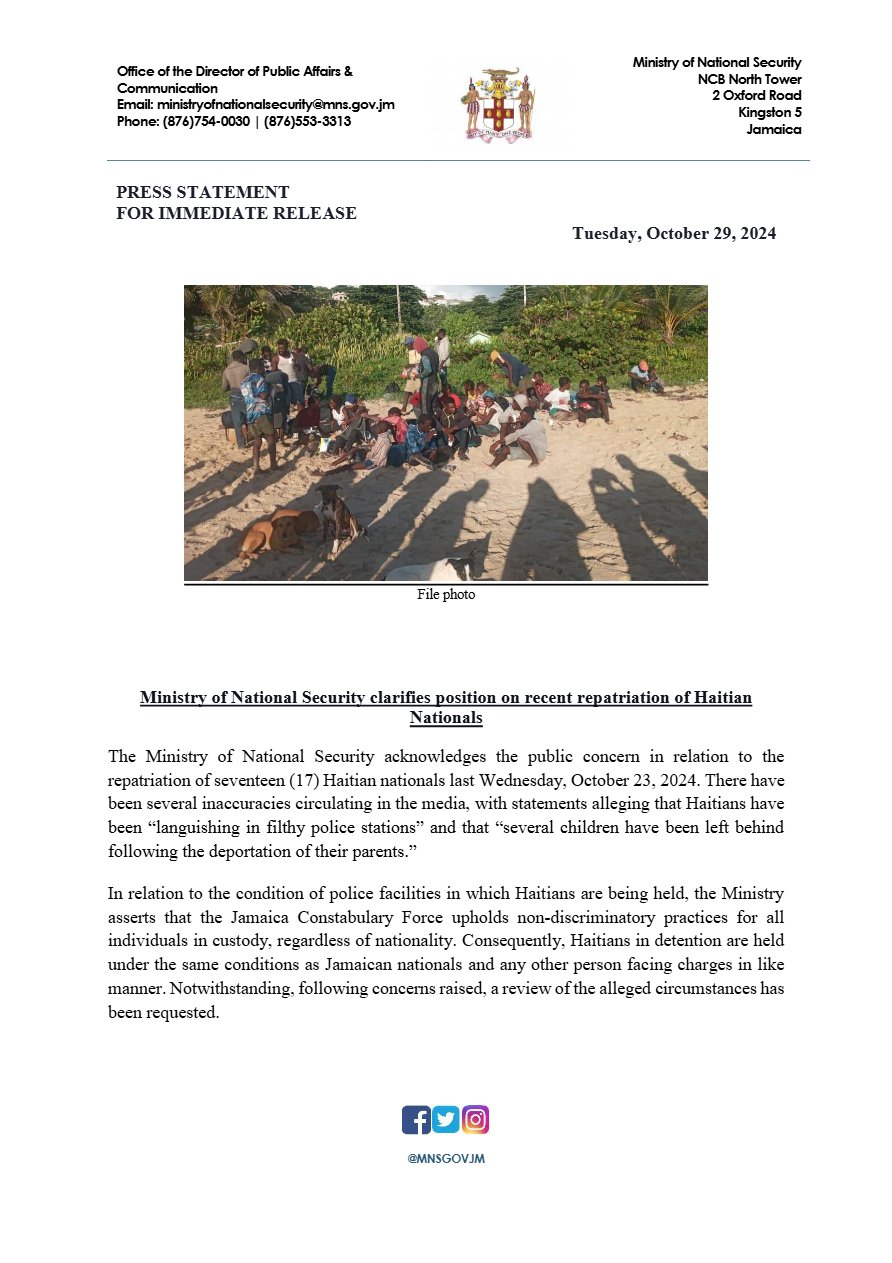
The Ministry of National Security acknowledges the public concern in relation to the repatriation of seventeen (17) Haitian nationals last Wednesday, October 23, 2024. There have been several inaccuracies circulating in the media, with statements alleging that Haitians have been “languishing in filthy police stations” and that “several children have been left behind following the deportation of their parents.”
In relation to the condition of police facilities in which Haitians are being held, the Ministry asserts that the Jamaica Constabulary Force upholds non-discriminatory practices for all individuals in custody, regardless of nationality. Consequently, Haitians in detention are held under the same conditions as Jamaican nationals and any other person facing charges in like manner. Notwithstanding, following concerns raised, a review of the alleged circumstances has been requested.
The Ministry refutes the claims of children being left behind and asserts that all Haitian children who arrived as part of the different groups, currently remain in the care and protection of the state and either has a parent or guardian who is also in state custody. Jamaica embraces the principle of non-separation of children from their parents and seeks to preserve these ties whenever they are established.
It should be noted that the group of Haitian nationals repatriated on October 23, 2024, comprised individuals who arrived in Jamaica illegally and were discovered by either the police or immigration officials, after being in the island without proper documentation, and failing to present themselves to the authorities.
While the group of Haitians who arrived in Jamaica in July 2023, subsequently sought asylum and currently remain in the island and are receiving care and protection from the Jamaican Government, while they complete the Refugee Status Determination process.
All other Haitian nationals from the groups of illegal entrants have matters at different stages in the court and their immigration status will be considered further, as appropriate when those matters are concluded.
Since July 2023, the Government has spent close to $30 million to support the needs of Haitian migrants who remain in Jamaica. This includes costs associated with shelter, meals, healthcare needs and other humanitarian supplies.
At present, there are approximately 99 Haitian migrants in state custody, 73 of which are under an interim injunction issued by the Supreme Court to stay deportation from Jamaica. Also included in the group are asylum seekers and minors, some in the care of their parents and some under the care of the Child Protection and Family Services Agency (CPFSA).
The Jamaican law enforcement sources have confirmed that the uptick in the movement of migrants is part of a lucrative smuggling operation that has intensified, consequent on the socio-political issues and gang activities in certain parts of Haiti. In response, Jamaica has strengthened its vetting process of illegal migrants.
It is important to highlight that Jamaica simply cannot afford to normalise irregular and/or illegal migration from neighbouring states. This would fundamentally compromise the integrity of its borders and would elevate this threat to national security, as well as compound the challenges with domestic crime and violence. The population of Haiti outnumbers Jamaica’s and could easily overwhelm its capacity to maintain the rule of law if illegal migration was left unabated.
The Government of Jamaica stands behind its commitment to supporting a more sustainable approach for improving the security situation in Haiti. Jamaican troops have been deployed, with personnel from other CARICOM countries, to support those efforts on the ground alongside the police contingent from Kenya. Early reports indicate positive changes in areas of Port-au-Prince, where the gang violence is most concentrated.
Photos
View album in the Gallery →