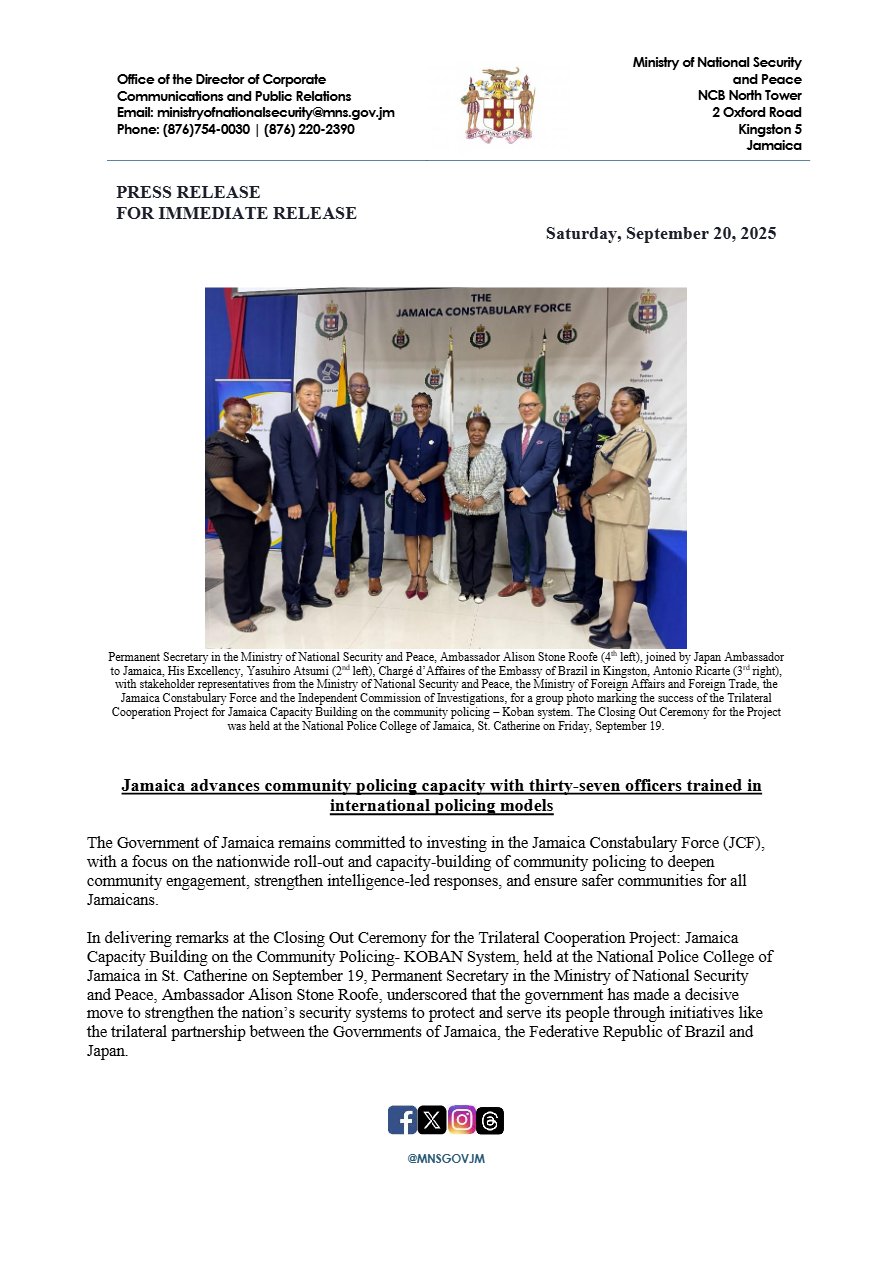
The Government of Jamaica remains committed to investing in the Jamaica Constabulary Force (JCF), with a focus on the nationwide roll-out and capacity-building of community policing to deepen community engagement, strengthen intelligence-led responses, and ensure safer communities for all Jamaicans.
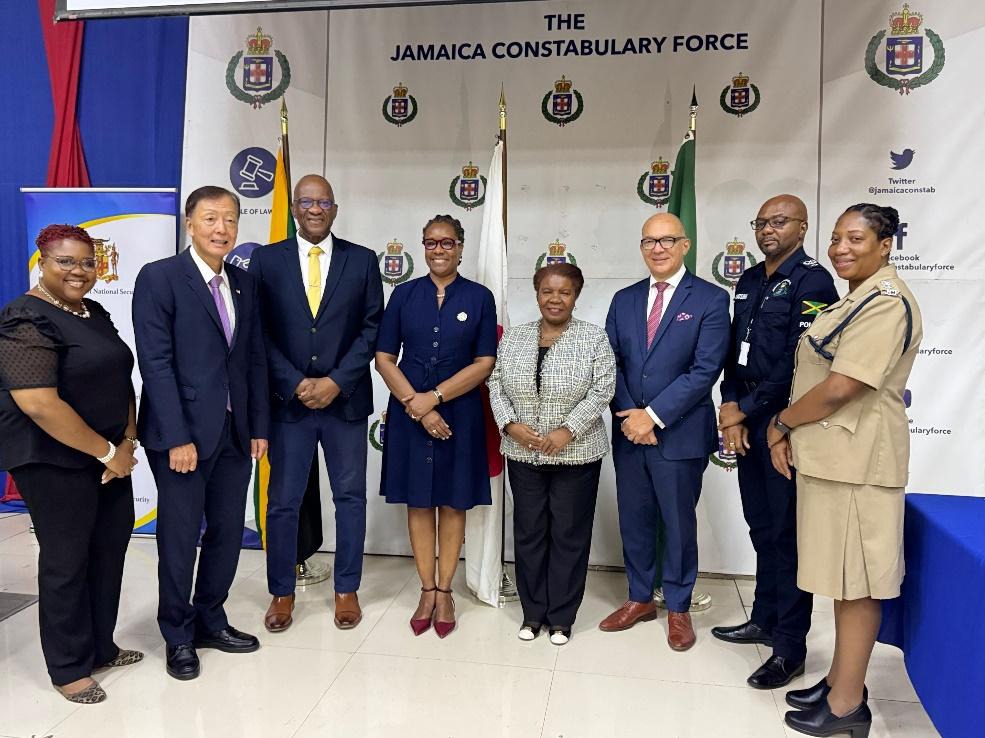
In delivering remarks at the Closing Out Ceremony for the Trilateral Cooperation Project: Jamaica Capacity Building on the Community Policing- KOBAN System, held at the National Police College of Jamaica in St. Catherine on September 19, Permanent Secretary in the Ministry of National Security and Peace, Ambassador Alison Stone Roofe, underscored that the government has made a decisive move to strengthen the nation’s security systems to protect and serve its people through initiatives like the trilateral partnership between the Governments of Jamaica, the Federative Republic of Brazil and Japan.
“Initiatives such as this Trilateral Cooperation Project, provide a vital platform for us to exchange knowledge, strengthen partnerships and develop innovative strategies to eradicate the plague of crime and violence and the stronghold they have across our nations and in our communities” she explained.
She further added that “...the Community Policing-KOBAN System policing model within the Jamaica Constabulary Force (JCF), extends beyond an operational milestone. It is the tangible result of international cooperation in practice.”
PS Stone Roofe used the occasion to highlight Community Policing’s central role in the transformation of the nation’s law enforcement infrastructure, stating, “community policing builds trust and strengthens security by prioritising open communication and direct collaboration between police and communities, and in doing so, redefines policing from enforcement to partnership which is critically important throughout our beloved island.”
As the Force continues to improve its operational capacity, community policing is set to fuel familiarity, humanise the police force and allow residents to see officers as allies who genuinely care about their well-being.
Ambassador Stone Roofe shared that Jamaica continues to employ crime‑reduction strategies that have yielded numerous successes in the fight against crime and violence, noting that “we have established three (3) mobile community police posts, ten (10) Domestic Violence Intervention Centres that offer counselling service to victims of domestic violence” adding that, “programmes such as Police Youth Clubs, a Safe Schools Programme and Neighbourhood Watch Programmes have engaged over one million Jamaicans in Quarter 1 and over 2.3 million citizens in Quarter 2 of fiscal year 24/25 through the Community Safety and Security Branch of the JCF”.
She noted that “these figures reflect not only the persistence of the government but also our renewed determination to own this transformative shift from enforcement to engagement, from control to collaboration and from fear to trust within our communities.”
For his part, Japan Ambassador to Jamaica, His Excellency, Yasuhiro Atsumi, shared that “community policing is the key for maintaining order and improving public safety in Jamaica” and reaffirmed Japan’s commitment to support Jamaica’s law enforcement transformation.
Meanwhile in his address, Chargé d’Affaires of the Embassy of Brazil in Kingston, Antonio Ricarte, outlined that “from the pre-training mission to Brazil in October 2023, to the first cohort of Jamaican officers trained in São Paulo in March 2024, and the two successful technical missions in 2025, this cooperation has been much more than a policy framework. It has been a living, breathing example of South-South and Trilateral cooperation in action”.
The 30-month Trilateral Project forms part of the basis on which the Ministry of National Security and Peace continues to invest in the complete transformation of the Force. Thirty-seven (37) officers from Areas 1 through 5 were trained in best practices drawn from the Japanese Koban community-based policing model, which were adopted in Brazil and now serve as complementary tools in the Jamaican context.
Photos
View album in the Gallery →